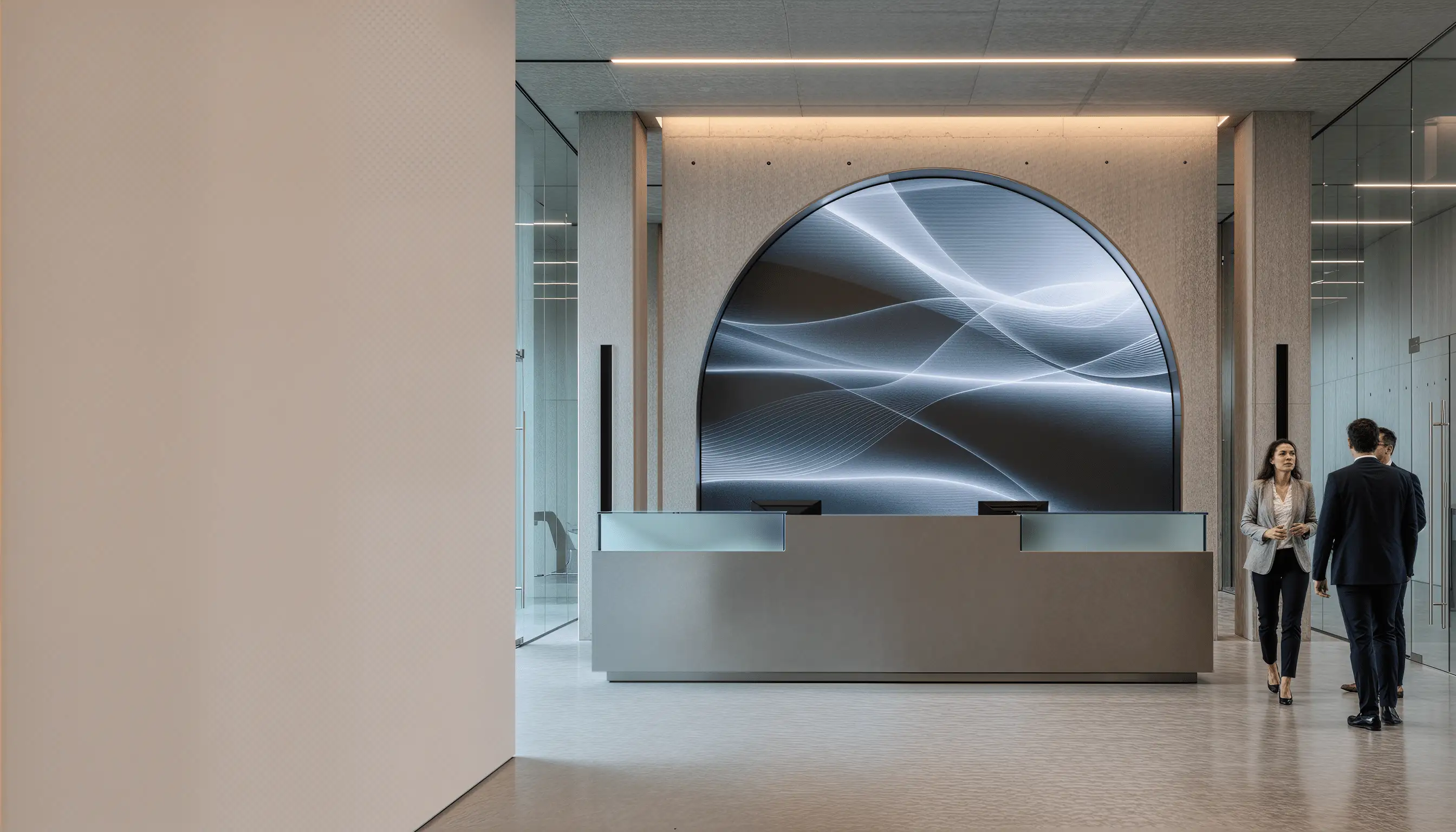

Videowall Reception Area Ideas: Concepts for B2B Companies

Einzelnes Blog-Bild

Videowall Reception Area Ideas: Concepts for B2B Companies

The reception area shapes the first personal impression of a company. For B2B organizations, this moment is decision-relevant: visitors, customers, partners, or applicants draw conclusions here about professionalism, organizational competence, and technical sophistication. However, there is often uncertainty about what concrete value a videowall actually delivers and how to use it effectively.

A videowall in the reception area is not merely a design element. It influences visitor flow, information quality, and internal operations. Missing goal definitions, inappropriate content, or isolated technical decisions quickly lead to the system falling short of its potential.

The following article contextualizes videowall reception area ideas from a B2B perspective. It examines strategic objectives, proven content concepts, technical planning aspects, and ongoing operations with a focus on typical decision factors and sustainable implementation.

Strategic Objectives and Value of Videowalls in Reception Areas

In brief: Videowalls deliver value only when they assume clearly defined tasks in the reception process.

Before deciding on technology or content, organizations should clearly establish the strategic objectives of a videowall. In the B2B context, the focus is not on short-term attention but on structured communication and orientation. The videowall should be a functional component of the reception architecture.

A central objective is targeted visitor guidance. Digital wayfinding, room information, and welcome messaging reduce inquiries at the reception desk and ease staff workload. In larger corporate headquarters or campus structures, this effect is particularly evident in daily operations.

Another benefit lies in brand impact. Videowalls enable consistent visual representation of brand values, innovations, and service portfolios. For investors, customers, or job applicants, this creates a professional overall impression that transcends traditional print or single-media approaches.

Information dissemination also plays an important role. Company news, safety information, or event announcements can be deployed current and across multiple locations. Compared to static displays, videowalls offer greater flexibility and better scalability.

Decision-makers should also consider long-term cost-effectiveness. When properly planned, a videowall can replace multiple individual media and reduce manual update efforts. Videowall reception area ideas should always be evaluated in the context of processes, staff efficiency, and brand strategy.

Content Concepts: What Actually Works on a Videowall

In brief: A videowall's success depends on content, not display size.

A videowall's value in the reception area depends heavily on the content. In practice, the conceptual effort is often underestimated while focus is placed on hardware. Sustainable videowall reception area ideas, however, begin with a clear content strategy.

Modular content that adapts to time of day or visitor type has proven effective. Mornings focus on welcome and orientation, while daytime features image and performance presentations. Special events can incorporate custom welcome screens and messages.

Visually, information should be presented calmly, clearly, and professionally. Brief text messages, visual key facts, and subtle animations are more effective in reception areas than complex presentations. The critical factor is rapid comprehension while passing by.

Typical content modules include company videos, reference projects, industry solutions, or live data like schedules and room bookings. The prerequisite is that content is updated regularly and provides recognizable value to visitors.

From an organizational perspective, a defined editorial process is recommended. Responsibilities, approvals, and update cycles should be clearly regulated to prevent inconsistent content. Professional videowall concepts treat content as an ongoing function, not a one-time setup task.

Technical Planning and Integration in the B2B Environment

In brief: Technical missteps have long-term impacts on operating costs and reliability.

Technical planning for a reception area videowall goes beyond selecting individual displays. What matters is the interplay of hardware, control, infrastructure, and structural conditions. Oversights in this phase often lead to high adjustment and follow-up costs.

A central decision criterion is display technology. LCD videowalls, direct-view LED, or all-in-one LED systems differ significantly in brightness, maintenance requirements, and scalability. Selection should be based on room size, viewing distance, and ambient light.

System architecture is equally important. Content management systems, player hardware, and network connectivity must be stable, secure, and maintainable. In the B2B environment, IT security requirements, remote management, and fault tolerance are central.

Integration into existing building and AV infrastructure should occur early. Aspects like power supply, cooling, mounting concept, and service access are often underestimated. Close coordination between AV planning, IT, and facility management is therefore essential.

Professional videowall reception area ideas also anticipate future requirements. Scalability, module exchangeability, and software updates help preserve the investment over many years.

Operations, Organization, and Success Measurement

In brief: Without clear operational structures, a videowall quickly loses effectiveness.

After installation, the actual lifecycle of a videowall begins. For B2B companies, structured operations are crucial to achieve lasting value. Without clear processes, content relevance diminishes in daily operations.

A central point is organizational embedding. Responsibilities for content, technology, and approvals should be clearly defined. Clear roles prevent delays and ensure content remains current and consistent.

Maintenance and monitoring should be planned from the start. Regular function checks, software updates, and defined service levels help minimize downtime. In reception areas, technical failures have immediate impact on external perception.

Both qualitative and quantitative criteria suit success measurement. Visitor feedback, reduced reception desk inquiries, or increased dwell time provide practical insights. Combined with clear objectives, this allows transparent value assessment.

In the long term, professional operational organization pays dividends. Videowall reception area ideas reach their full potential only when technology, content, and organization work together seamlessly.

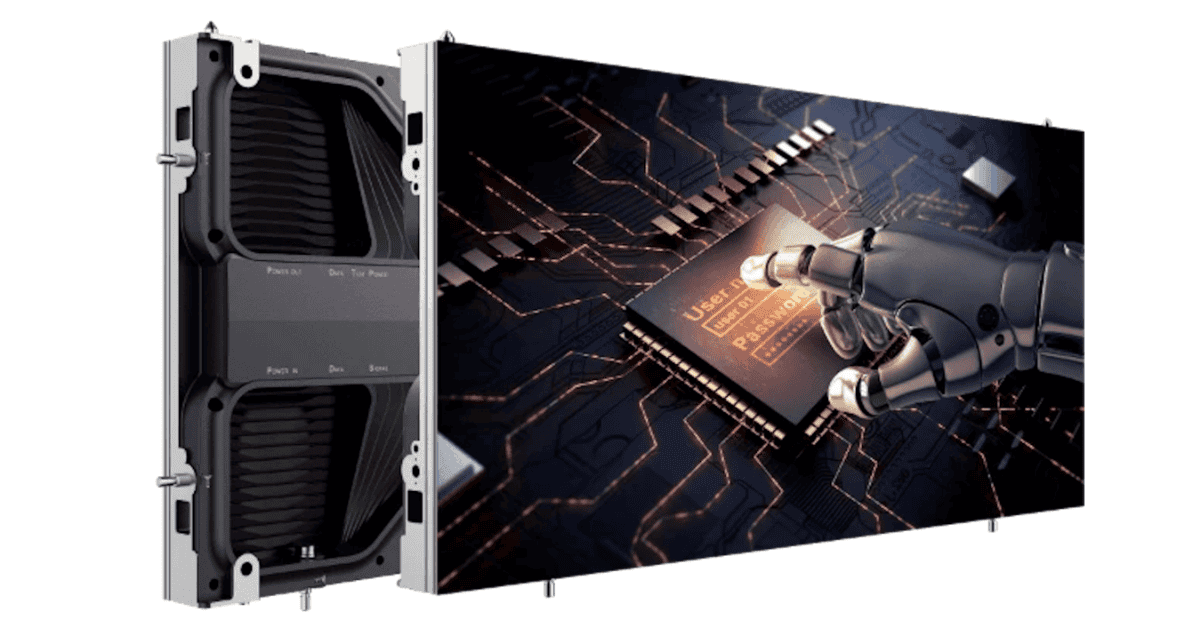
Looking for the right videowall or LED wall for your reception area? Request an LED wall for your reception area now.

Frequently Asked Questions (FAQ)

What budget should B2B companies expect for a reception area videowall?

Investment varies considerably depending on technology, size, and integration effort. Beyond acquisition costs, consider planning, installation, content creation, software licenses, and ongoing operational and energy expenses. A TCO analysis over several years supports well-founded decision-making.

Which pixel pitch is suitable for which viewing distance?

Appropriate pixel pitch depends on minimum viewing distance in the reception area. The closer the viewing distance, the finer the pixel pitch should be to ensure good legibility and image quality. Alignment with actual traffic flows and waiting areas is critical.

What brightness should a reception area videowall have?

In areas with strong daylight exposure, higher brightness values are required than in controlled interior spaces. Additionally, glare and reflections should be minimized through appropriate surfaces or positioning. Design should be based on actual lighting conditions.

What IT security requirements apply to networked videowalls?

Networked systems should integrate into existing IT security architecture, such as through network segmentation and role-based access. Regular software updates and controlled permission management reduce risks. For content involving personal data, data protection requirements also apply.

Which service level agreements (SLAs) make sense for reception areas?

For representative reception areas, defined response and recovery times are recommended. This includes remote diagnostics, clear escalation levels, and possibly on-site service. SLAs should match the operational criticality of the videowall.

How can the value of a reception area videowall be concretely measured?

Suitable metrics include reduced reception desk inquiries, more structured visitor flows, or qualitative feedback from guests. Internal efficiency gains through centralized content management can also be quantified. Clear goal definition before project launch is a prerequisite.

How can installation occur without disrupting ongoing reception operations?

Precise project planning with scheduled time windows outside peak visiting hours minimizes disruptions. Preparatory measures like pre-assembly, advance testing, and clear facility management coordination are essential. Temporary workaround solutions at the reception desk can provide additional security.

Conclusion: A videowall in the reception area is a strategic communication tool. With clear objectives, well-considered videowall reception area ideas, and professional implementation, it sustainably improves visitor guidance, brand impact, and information quality. For B2B decision-makers, it is less a design element than a functional component of modern corporate communication.

Related Articles

Learn more about related topics:
Cta V3 Bild
Artikel von

Kampro

Blog-Share-SymbolBlog-Share-SymbolBlog-Share-Symbol
Share on:
Blog Share IconBlog Share IconBlog Share IconBlog Share Icon

Videowall Reception Area Ideas: Concepts for B2B Companies

The reception area shapes the first personal impression of a company. For B2B organizations, this moment is decision-relevant: visitors, customers, partners, or applicants draw conclusions here about professionalism, organizational competence, and technical sophistication. However, there is often uncertainty about what concrete value a videowall actually delivers and how to use it effectively.

A videowall in the reception area is not merely a design element. It influences visitor flow, information quality, and internal operations. Missing goal definitions, inappropriate content, or isolated technical decisions quickly lead to the system falling short of its potential.

The following article contextualizes videowall reception area ideas from a B2B perspective. It examines strategic objectives, proven content concepts, technical planning aspects, and ongoing operations with a focus on typical decision factors and sustainable implementation.

Strategic Objectives and Value of Videowalls in Reception Areas

In brief: Videowalls deliver value only when they assume clearly defined tasks in the reception process.

Before deciding on technology or content, organizations should clearly establish the strategic objectives of a videowall. In the B2B context, the focus is not on short-term attention but on structured communication and orientation. The videowall should be a functional component of the reception architecture.

A central objective is targeted visitor guidance. Digital wayfinding, room information, and welcome messaging reduce inquiries at the reception desk and ease staff workload. In larger corporate headquarters or campus structures, this effect is particularly evident in daily operations.

Another benefit lies in brand impact. Videowalls enable consistent visual representation of brand values, innovations, and service portfolios. For investors, customers, or job applicants, this creates a professional overall impression that transcends traditional print or single-media approaches.

Information dissemination also plays an important role. Company news, safety information, or event announcements can be deployed current and across multiple locations. Compared to static displays, videowalls offer greater flexibility and better scalability.

Decision-makers should also consider long-term cost-effectiveness. When properly planned, a videowall can replace multiple individual media and reduce manual update efforts. Videowall reception area ideas should always be evaluated in the context of processes, staff efficiency, and brand strategy.

Content Concepts: What Actually Works on a Videowall

In brief: A videowall's success depends on content, not display size.

A videowall's value in the reception area depends heavily on the content. In practice, the conceptual effort is often underestimated while focus is placed on hardware. Sustainable videowall reception area ideas, however, begin with a clear content strategy.

Modular content that adapts to time of day or visitor type has proven effective. Mornings focus on welcome and orientation, while daytime features image and performance presentations. Special events can incorporate custom welcome screens and messages.

Visually, information should be presented calmly, clearly, and professionally. Brief text messages, visual key facts, and subtle animations are more effective in reception areas than complex presentations. The critical factor is rapid comprehension while passing by.

Typical content modules include company videos, reference projects, industry solutions, or live data like schedules and room bookings. The prerequisite is that content is updated regularly and provides recognizable value to visitors.

From an organizational perspective, a defined editorial process is recommended. Responsibilities, approvals, and update cycles should be clearly regulated to prevent inconsistent content. Professional videowall concepts treat content as an ongoing function, not a one-time setup task.

Technical Planning and Integration in the B2B Environment

In brief: Technical missteps have long-term impacts on operating costs and reliability.

Technical planning for a reception area videowall goes beyond selecting individual displays. What matters is the interplay of hardware, control, infrastructure, and structural conditions. Oversights in this phase often lead to high adjustment and follow-up costs.

A central decision criterion is display technology. LCD videowalls, direct-view LED, or all-in-one LED systems differ significantly in brightness, maintenance requirements, and scalability. Selection should be based on room size, viewing distance, and ambient light.

System architecture is equally important. Content management systems, player hardware, and network connectivity must be stable, secure, and maintainable. In the B2B environment, IT security requirements, remote management, and fault tolerance are central.

Integration into existing building and AV infrastructure should occur early. Aspects like power supply, cooling, mounting concept, and service access are often underestimated. Close coordination between AV planning, IT, and facility management is therefore essential.

Professional videowall reception area ideas also anticipate future requirements. Scalability, module exchangeability, and software updates help preserve the investment over many years.

Operations, Organization, and Success Measurement

In brief: Without clear operational structures, a videowall quickly loses effectiveness.

After installation, the actual lifecycle of a videowall begins. For B2B companies, structured operations are crucial to achieve lasting value. Without clear processes, content relevance diminishes in daily operations.

A central point is organizational embedding. Responsibilities for content, technology, and approvals should be clearly defined. Clear roles prevent delays and ensure content remains current and consistent.

Maintenance and monitoring should be planned from the start. Regular function checks, software updates, and defined service levels help minimize downtime. In reception areas, technical failures have immediate impact on external perception.

Both qualitative and quantitative criteria suit success measurement. Visitor feedback, reduced reception desk inquiries, or increased dwell time provide practical insights. Combined with clear objectives, this allows transparent value assessment.

In the long term, professional operational organization pays dividends. Videowall reception area ideas reach their full potential only when technology, content, and organization work together seamlessly.

Looking for the right videowall or LED wall for your reception area? Request an LED wall for your reception area now.

Frequently Asked Questions (FAQ)

What budget should B2B companies expect for a reception area videowall?

Investment varies considerably depending on technology, size, and integration effort. Beyond acquisition costs, consider planning, installation, content creation, software licenses, and ongoing operational and energy expenses. A TCO analysis over several years supports well-founded decision-making.

Which pixel pitch is suitable for which viewing distance?

Appropriate pixel pitch depends on minimum viewing distance in the reception area. The closer the viewing distance, the finer the pixel pitch should be to ensure good legibility and image quality. Alignment with actual traffic flows and waiting areas is critical.

What brightness should a reception area videowall have?

In areas with strong daylight exposure, higher brightness values are required than in controlled interior spaces. Additionally, glare and reflections should be minimized through appropriate surfaces or positioning. Design should be based on actual lighting conditions.

What IT security requirements apply to networked videowalls?

Networked systems should integrate into existing IT security architecture, such as through network segmentation and role-based access. Regular software updates and controlled permission management reduce risks. For content involving personal data, data protection requirements also apply.

Which service level agreements (SLAs) make sense for reception areas?

For representative reception areas, defined response and recovery times are recommended. This includes remote diagnostics, clear escalation levels, and possibly on-site service. SLAs should match the operational criticality of the videowall.

How can the value of a reception area videowall be concretely measured?

Suitable metrics include reduced reception desk inquiries, more structured visitor flows, or qualitative feedback from guests. Internal efficiency gains through centralized content management can also be quantified. Clear goal definition before project launch is a prerequisite.

How can installation occur without disrupting ongoing reception operations?

Precise project planning with scheduled time windows outside peak visiting hours minimizes disruptions. Preparatory measures like pre-assembly, advance testing, and clear facility management coordination are essential. Temporary workaround solutions at the reception desk can provide additional security.

Conclusion: A videowall in the reception area is a strategic communication tool. With clear objectives, well-considered videowall reception area ideas, and professional implementation, it sustainably improves visitor guidance, brand impact, and information quality. For B2B decision-makers, it is less a design element than a functional component of modern corporate communication.

Related Articles

Learn more about related topics:

Cta V3 Image
Article by

Kampro

Blog Share IconBlog Share IconBlog Share Icon