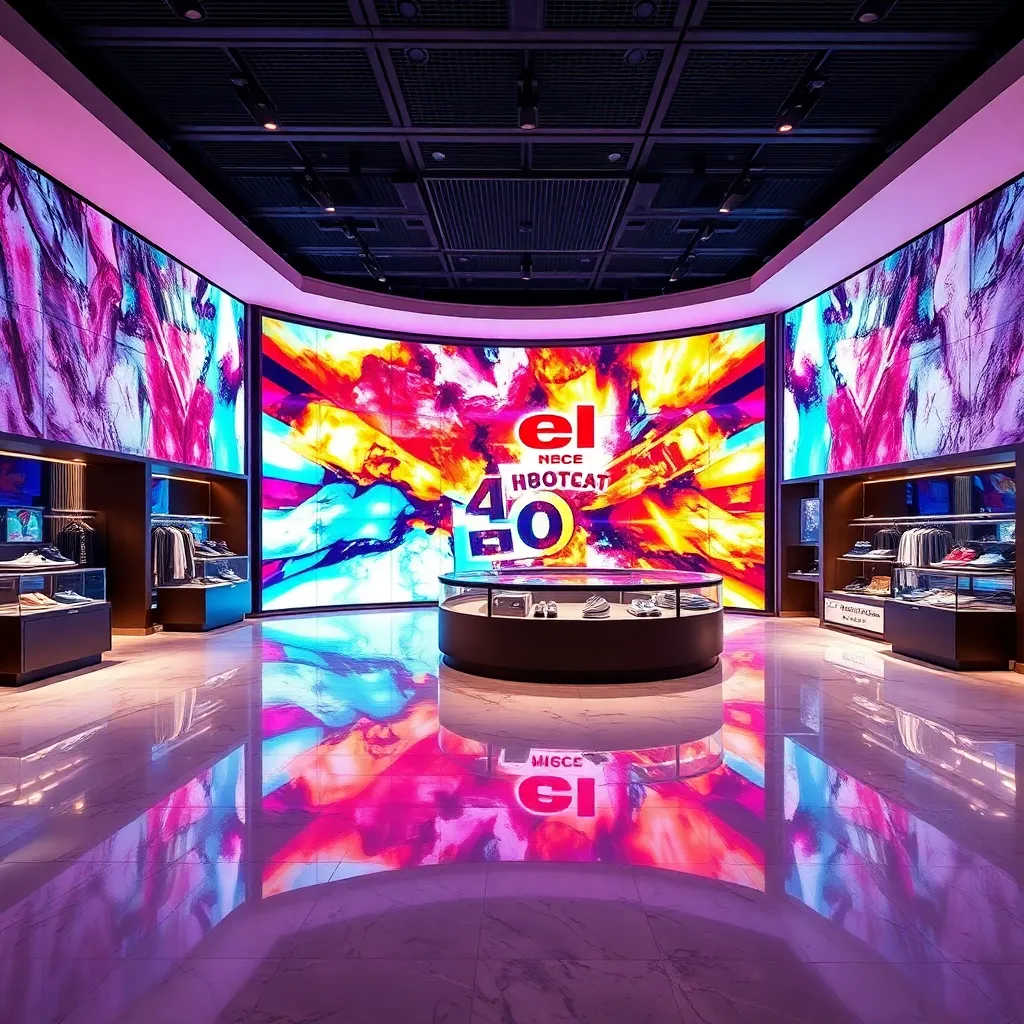
DIGITAL SHOP WINDOW: 2026 GUIDE

How retailers win more customers with the right display technology

Why static shop windows no longer do the job, which display technology actually works, and what it costs.

400%

more views than posters

+8.1%

purchase probability

87.7%

of the extra revenue comes from displays

A digital shop window replaces the printed poster with a display that shows changing offers and videos. For use behind glass you have three options: a high-brightness monitor, shop window projection, or an LED wall. Kampro compares all three honestly on cost, brightness and ROI, and advises you free of charge.

Picture this: a passerby walks past your store. Phone in hand, eyes down. The next three seconds decide whether they look up, stop, or keep walking. Moving images on a digital display work far better here than a static poster.

The reality in German retail in 2026: footfall in German city centers still has not returned fully to pre-Covid levels. According to IFH Köln („Vitale Innenstädte 2024“) frequencies are close to pre-Covid levels, yet Hystreet data shows individual locations still 7 to 10 percent below 2019 (source: IFH Köln, immobilienmanager.de 2024). At the same time, HDE managing director Stefan Genth is blunt about it: German city centers are struggling and need lasting support (source: ZDF.de). Online shopping keeps growing. And the stores that still manage to pull customers through the door? Almost all of them use digital attention magnets in the shop window.

In this guide we show you which technologies exist, what they cost, which mistakes to avoid, and what determines when the investment pays for itself. No invented numbers, just honest, verifiable data for the German retail market.

Why classic shop windows no longer work

The shop window has been the calling card of brick-and-mortar retail for over 100 years. But the rules have changed fundamentally. Several factors are making classic shop windows steadily less effective:

The attention crisis

The average passerby gives you 3 to 5 seconds of attention. In that time your shop window has to land a message strong enough to make someone stop. A static poster stands no chance against a bright, moving display. Moving images trigger the orienting reflex: our brain turns towards movement automatically.

Falling footfall

Footfall in German city centers is still a critical issue. Hystreet.com recorded frequencies up 1.5% year on year in 2024, but individual streets remain 7 to 10 percent below their 2019 levels. Every passerby outside your store is worth more than ever.

The online expectation

Consumers are used to dynamic, personalized content online. Product videos, customer reviews, animated offers. When they then stand in front of a window that has shown the same poster for three weeks, it simply looks dated.

The high cost of redressing by hand

Redressing a shop window for the season costs several thousand euros: decoration, printed material, labor. At 4 to 6 changes a year that adds up considerably. Digital: content changes at the click of a mouse, in seconds instead of hours.

Falling behind on digitization

According to BITKOM, 77% of retailers see themselves as laggards on digitization. 82% see the current economic crisis as a crisis of hesitant digitization as well. Only 30% use social media at all. Whoever digitizes stands out from the competition.

Digital signage generates 400% more views than static displays (MVIX 2025). A 2025 study covering 30 million shopper visits found that displays raise purchase probability by 8.1%, with 87.7% of the additional revenue traceable directly to digital signage (RetailTouchPoints 2025). Companies report increased foot traffic after installation (RiseVision 2025).

The 3 display options for your shop window

If you want to digitize your shop window, three basic technologies are available. Each has clear strengths and equally clear limits. The right choice depends on the size of your window, how much sun it gets, and your budget.

Modernes Schaufenster mit Display

High-brightness monitor

Purpose-built shop window monitors with raised brightness (700 to 2,500 cd/m², compared with 300 to 500 cd/m² on a normal TV). Available from 43 to 75 inches. Mounted directly in the window and driven through a CMS, often from your phone via cloud software.

Entry level

affordable, price depends on size and brightness

+ Fast installation, simple to operate, sharp 4K image, good entry price

− Often too dim in direct sun, 75 inches maximum, heat build-up behind glass

Suits: windows with little direct sun (north-facing, covered), small to medium areas, entry-level budgets.

Beleuchtetes Schaufenster bei Nacht

Shop window projection

Rear projection onto a special film bonded to the inside of the glass. A projector (3,000 to 6,000 lumens) projects onto the film from inside, and from the street the passerby sees an image floating on the glass. Particularly striking after dark.

Entry level

affordable, price depends on projector, film and installation

+ Large format (up to 3 m and beyond), creative wow factor, transparent, no visible hardware

− Barely visible in daylight, needs maintenance, lower image quality, film can come loose

Suits: evening hospitality, bars, fashion boutiques with long evening hours, creative staging.

Große LED Wand im Retail-Umfeld

LED wall in the shop window

The premium option: an LED wall installed directly in or behind the shop window. Modular build in any size, from 1 × 0.5 m up to the full width of the window. Brightness of 3,000 to 6,000+ cd/m² keeps it perfectly readable even in direct sunlight.

from €600/m²

up to €3,000/m² depending on pixel pitch, plus VAT and installation

+ Highest brightness, any size, modules replaceable individually, cloud CMS, no fan required

− Higher purchase price, pixel pitch has to match the viewing distance, professional installation required

Suits: sunlit windows (south or west facing), high-traffic locations, premium brands, flagship stores, real estate offices, car dealerships.

An honest comparison: monitor vs. projection vs. LED wall

No marketing speak, just a fair comparison of all three technologies against the criteria that matter day to day in a shop window.

Monitor (HB)
Projection
LED wall
Brightness
700 to 2,500 cd/m²
Enough for shaded or north-facing windows
800 to 2,000 lm
Only effective after dark
3,000 to 6,000+ cd/m²
Perfect even in direct sun
Max. size
75" (1.65 m)
One display per window
Up to 3+ m wide
Flexible, but soft
Any size
Modular build, made to measure
Visible in sunlight?
Partly
Fades in direct sunlight
No
Only visible from dusk
Yes
Readable even at 50,000+ lux
Image quality
Very good (4K)
Sharp image
Moderate
Soft, low resolution
Good to very good
Depends on the pixel pitch
Changing content
Via CMS / USB
Simple, instant
Via HDMI
Manual
Via cloud CMS
Remote control, scheduled
Service life
Limited
The whole display is replaced
Short
Lamp changes needed
Long
Modules replaceable individually
Maintenance
Low
Occasional cleaning
Medium
Lamp, film, alignment
Minimal
Modules swapped as needed
Wow factor
Medium
Looks like a big TV
High (at night)
Image floating on the glass
Very high
Large, bright, impressive

The sunlight factor: why brightness decides everything

The biggest misconception when buying a shop window display: a bright monitor is enough. That is true, but only if your window sits in the shade. On a sunny day in Germany, ambient brightness reaches 60,000 to 100,000 lux. Even on an overcast day it is 10,000 to 25,000 lux. A normal monitor at 500 cd/m² is already hard to read at 10,000 lux. And with direct sun on the window? Then you need at least 4,000 cd/m², and only an LED wall can deliver that. On top of that, a greenhouse effect builds up behind glass. Monitors overheat easily and projection films fade. LED walls are temperature-resistant and self-cooling.

A monitor from 1,500 cd/m² is enough.

A monitor with 2,500 cd/m² or an LED wall.

Only an LED wall with 4,000+ cd/m² works reliably.

Monitor 500
HB monitor 2,500
LED 6,000+
Dark Overcast (10k lux) Sun (60k lux) Direct sun (100k+ lux)

What does a digital shop window cost?

The cost depends on three factors: technology, size and content strategy. Here is an overview for the German market in 2026:

Budget option

High-brightness monitor

Entry level

price depends on size and brightness

Display: 55 to 75", 2,500 cd/m²

Mount: depends on the mounting type

CMS license: depends on the provider, usually monthly

One-off: display, mount, installation

Ongoing: power and CMS license

Mid-range

Shop window projection

Mid-priced

price depends on projector, film and installation

Projector: 4,000+ lumens

Film: depends on the area

Installation: depends on the effort

One-off: projector, film, installation

Ongoing: power, lamp and film

Premium

LED wall

from €600/m²

up to €3,000/m² depending on pitch, plus VAT and installation

LED modules: largest share of the cost

Controller: control and playback

Installation: charged separately

Pixel pitch: P2.5 to P3 recommended

Ongoing: power and CMS license

TCO: the real cost over 5 years

The purchase price is what you pay once. TCO (total cost of ownership) is what you really pay. Here are the cost items for a shop window display of roughly 2 × 1 m, compared:

Cost itemMonitor 55"ProjectionLED wall (2 m²)
Purchaselowlow€600 to €3,000 per m² plus VAT and installation
Installationlowmediumprofessional installation, charged separately
Content creationdepends on scopedepends on scopedepends on scope
Powerlowdepends on wattage and running hourslowdepends on wattage and running hoursmediumdepends on area, brightness and running hours
CMS licenseongoingmonthly licensenonemanualongoingmonthly license
Maintenancelowmediumlamp + new filmlow
Replacementcompletenew display neededpartialnew film, possibly a new projectorsingle modulesinstead of the whole wall
Service lifelimitedthen a new purchasefilm and lamp limitedregular replacementlongmodules replaceable individually

What matters for the cost

An LED wall costs more than a monitor to buy. In return it delivers consistently high brightness, is visible in any weather, and you replace single modules, not the whole wall. If you plan to stay at your location for longer, work out the total cost over the years.

Then there is the deciding factor: revenue impact. An LED wall that still shines in sunlight stays visible to passersby. A monitor that fades in the sun is easily overlooked.

Ready for your digital shop window?

A personal initial consultation including an ROI calculation: free, no obligation and honest.

Book a free consultation

ROI calculation: when does the investment pay off?

The question every retailer cares about most: when do I get my money back? That mainly depends on four factors:

Foot traffic outside your store

Margin per sale

Technology and location

Content and upkeep

Your calculation

Your numbers
decide when your digital shop window pays off
Monitor
Affordable start for shaded shop windows
LED wall
€600 to €3,000 per m² plus VAT and installation

Content strategy: what do you actually show?

The hardware is only half the job. Content decides whether your digital shop window works or not. Here are the content formats that have proven themselves in retail:

Dynamic offers

Changing daily offers, flash sales, countdown timers. Creates urgency and gets people through the door. Works especially well in fashion, electronics and food.

Lifestyle videos

Short product videos (5 to 15 seconds) that show the product in context. Not a still of a dress on a hanger, but a person wearing it and walking through a city.

Social proof

Customer reviews, Instagram posts from customers, Google ratings. The message: other people buy here and they are happy. Especially effective for restaurants, service businesses and niche products.

Time-of-day content

Mornings: coffee offers. Midday: lunch deals. Evenings: after-work specials. Switching automatically on a CMS schedule. Shows relevance and freshness.

Interactive elements

QR codes that lead to discounts, gamification (quiz, giveaway), touchscreen features. The highest engagement rate, but more work to produce.

One important tip: less is more. A display that flashes every 5 seconds is annoying and gets ignored. The optimal dwell time per content element is 8 to 15 seconds. Use no more than 5 to 8 different pieces per rotation.
Checklist: which solution fits your business?

Use this checklist to identify the right technology for your shop window:

🖥️ Choose a monitor if…

✓ your shop window gets little direct sun (north-facing, covered)
✓ you want to start with a small budget
✓ you need a single screen of up to 75 inches
✓ you want to get started quickly (plug and play)
✓ you already have a CMS or content management software

📽️ Choose projection if…

✓ your business is busiest in the evening or at night (restaurant, bar, club)
✓ you want to fill a large area without hardware in the window
✓ the creative wow factor (an image floating on the glass) matters
✓ no daylight hits the window directly

💡 Choose an LED wall if…

✓ your shop window gets sun (south or west facing)
✓ you have a high-traffic location (pedestrian zone, shopping center)
✓ your brand needs a premium presence
✓ you need more than 75 inches of screen
✓ long-term investment security matters to you (modules replaceable individually)
✓ maximum attention in any weather is a priority
✓ you want to run several locations centrally (cloud CMS)
Fashion-Store Schaufensterfront bei Nacht

Robert Ley flagship store, Mülheim-Kärlich

How an established fashion retailer digitized its shop window with a transparent LED wall of more than 40 m².

Robert Ley is an established German fashion retailer (womenswear and menswear) with several locations. The flagship store in Mülheim-Kärlich digitized its shop window in 2025. The starting point: a prominent location with a large window front, south-west facing, with strong afternoon sun.

The solution: a high-resolution mesh LED wall, transparent in construction, roughly 9 × 4.5 meters. Cloud-based digital signage software handles central content planning, automatic updates and remote control. Installed by Buetema AG.

9 × 4.5 m

LED area

40+ m²

Display size

Mesh

Transparent structure

Cloud

Central control

What the installation demonstrates: large, high-traffic locations exposed to sun need robust, bright LED technology. The transparent LED wall gets maximum attention while keeping the shop window experience, the view into the store, intact. Cloud-based control makes it possible to run campaigns centrally, which matters for chains with several locations.

Sources: buetema-ag.de, sixteen-nine.net, invidis.de (April 2025).

FAQ: Digital shop windows

What is a digital shop window?

+

A display in your shop window that shows changing content, such as offers, videos and promotions, instead of static posters. It can be a monitor, a projection or an LED wall.

Monitor, projection or LED wall: which one is right?

+

It mainly comes down to how bright the image needs to be behind glass. A monitor or a projection costs less to buy, but only suits shaded windows or windows used mainly in the evening. An LED wall costs €600 to €3,000 per m² plus VAT and installation and stays visible even in direct sun.

Why does brightness matter so much in a shop window?

+

Behind glass and in daylight, standard screens look washed out. Only displays that are bright enough stay visible during the day, which makes brightness the key selection criterion.

When does a digital shop window pay off?

+

That depends on foot traffic, content and the technology you choose. On request, Kampro works out the ROI with your own figures free of charge.

Conclusion: which investment makes sense for you?

A digital shop window is not a gimmick and not a luxury, it is a measurable investment in footfall and revenue. At a time when every passerby counts and the online competition is one click away, the right display technology decides between a busy store and an empty one.

Monitor

A fast, affordable start

A high-brightness monitor is the best choice: affordable, quickly installed, ready to go. Ideal for shaded locations and small budgets.

Projection

Creative staging after dark

Shop window projection costs less than LED and is impressive at night, but it has no effect in daylight. Ideal for evening hospitality.

LED wall

Maximum impact in any weather

The LED wall offers the highest brightness and the strongest pull on attention. At €600 to €3,000 per m² plus VAT and installation it costs more, but you replace single modules, not the whole wall.

One thing is clear: anyone still relying on paper posters in the shop window in 2026 is losing customers to the competitor who is not. Digitization is no longer optional, it is a survival factor in modern retail.

Ready for your digital shop window?

We will advise you personally on which display solution fits your location. The initial consultation and the ROI calculation are free.

Book a free consultation

Sources and references

All statistics come from verified sources: IFH Köln, Hystreet, BITKOM, RiseVision, MVIX, WorldMetrics, POPAI, Samsung, RetailTouchPoints, Grand View Research.