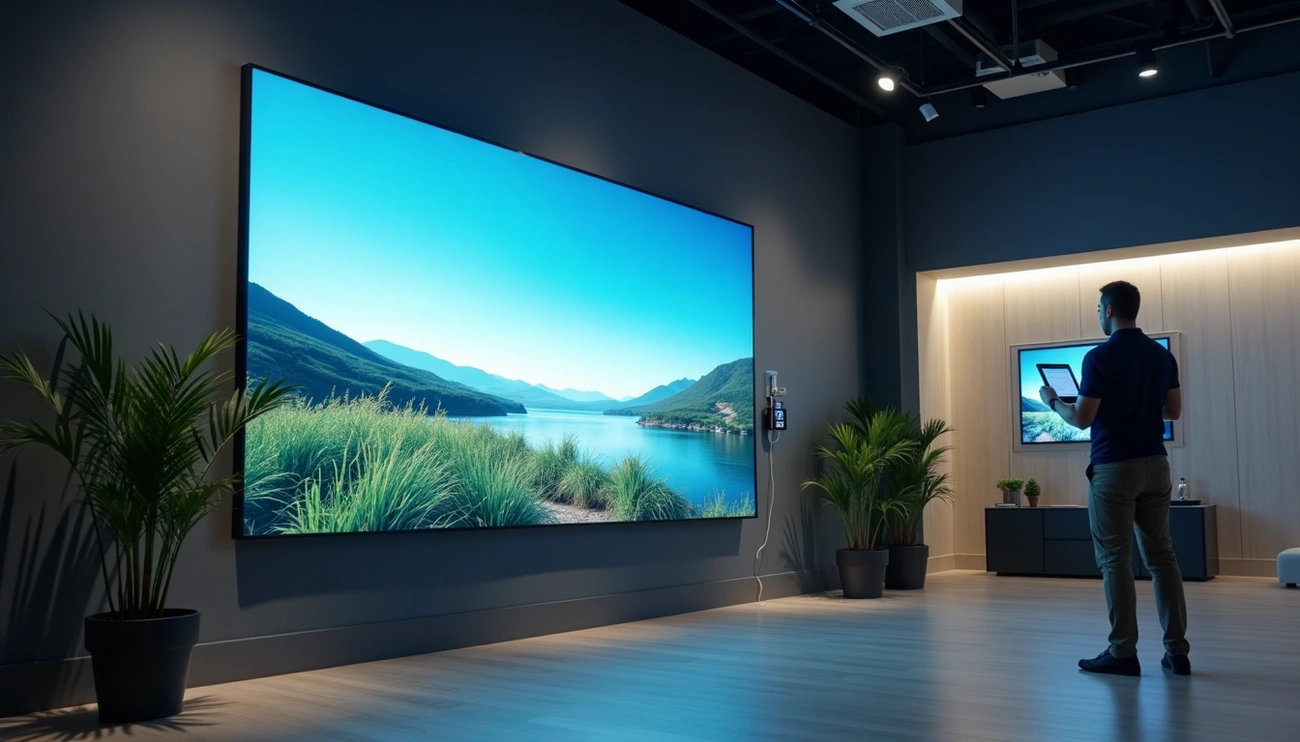

Technical Specifications of LED Walls Explained

LED Wall Tips
Einzelnes Blog-Bild

Technical Specifications of LED Walls Explained

Procuring an LED wall in B2B projects is rarely a pure display decision. It influences brand impact, information quality, operational safety, and – depending on the application – also production processes for live content. This is precisely where typical misconceptions arise: datasheets appear definitive, but in practice they are only reliable when specifications are interpreted under real operating conditions. What looks "brilliant" in a showroom can reveal unexpected weaknesses in a bright lobby, control room, or in front of a camera.

Three questions are particularly relevant for decision-making: What image quality is actually achievable in the target space? What risks arise from incorrect dimensioning (e.g., overheating, glare, poor black levels, camera artifacts)? And which specifications should be specifically verified in tenders and acceptance protocols to avoid expensive rework later?

This article explains the most important technical specifications for evaluating LED walls in B2B contexts: brightness, refresh rate, and contrast as core parameters – supplemented by metrics that are regularly overlooked in tender documents. The goal is to provide a solid decision foundation that avoids typical pitfalls and enables the right questions to be asked to integrators, manufacturers, and rental companies.

Practice shows this: there is no "best" LED wall, only one correctly specified for the application, viewing distance, ambient light, content type, and operational model. When you properly interpret specifications, you reduce risk, avoid costly rework, and get a system that delivers the expected image quality even after two years of operation.

Brightness (Nits): What the value really means and how to dimension it correctly

The essentials: What matters is not the maximum value in the datasheet, but usable brightness in daily operation – including stable color reproduction at the dimming levels actually used. Over-dimensioning can increase operating costs, heat generation, and acoustic problems.

Brightness in an LED wall is specified in cd/m² (nits) and is usually the first metric in the datasheet. However, the maximum value is not what matters, but rather usable brightness in operation: with desired color reproduction, homogeneous white surfaces, and stable power consumption. Many systems achieve high peak nits only in certain image areas or with reduced white content, while full-screen white may be significantly lower.

For B2B applications, ambient brightness is the driver of the specification. In a typical bright lobby with daylight, 800 to 1,500 nits are often appropriate, depending on glass surfaces, angle of incidence, and desired "punch" effect. In conference rooms and auditoriums, 400 to 800 nits often suffice when glare is avoided and content is primarily presentations and video. For semi-outdoor or storefront situations, significantly higher reserves may be necessary, with thermal management and energy requirements becoming integral to planning.

The question of how brightness is controlled is important. Good systems offer fine-grained dimming steps while maintaining stable color temperature and gamma, even at significantly reduced brightness for evening operation. In practice, many complaints do not arise from insufficient maximum brightness, but from unstable color balance at 10 to 30 percent brightness when, for example, an LED wall automatically dims at night.

A typical decision dilemma: "We want as bright as possible to be prepared for all cases." This can backfire, as higher nits often mean higher power consumption, more heat generation, potentially louder cooling, and in extreme cases, higher mechanical stress. Moreover, very high brightness reserves increase the risk that operators will run the system too bright in everyday use, creating discomfort in the space and contributing to faster aging. Better is a specification that covers target brightness in normal operation and offers a modest reserve for exceptional situations.

Practical example: A corporate headquarters replaces video walls with a large-format LED wall in the atrium. The integrator calculates 1,200 nits because direct sunlight is possible at noon. In parallel, a brightness sensor with time profile is deployed: 70-80 percent during the day, 20-30 percent in the evening. At acceptance, not just "max nits" are measured, but readability of fine text and skin tones at 30 percent, because that's where the wall operates most of the time.

Market trend: More and more manufacturers are linking brightness and energy efficiency through optimized drivers, more efficient LEDs, and better calibration procedures. For decision-makers, it's worthwhile not only to compare nits, but to look at nits per watt in target operation and whether the system offers reliable, automatic brightness control that matches usage patterns. This is particularly relevant for 24/7 applications and ESG-oriented procurement policies.

Refresh Rate and Image Processing: Why 3,840 Hz doesn't automatically mean "camera-friendly"

The essentials: A high refresh rate reduces flicker, but is not the sole criterion. Camera compatibility only emerges from the interplay of driver, PWM/scan, controller processing, and the specific camera and production parameters.

The refresh rate (frame rate) of an LED wall is often specified in hertz, typically 1,920 Hz, 3,840 Hz, or higher. In a B2B context, the number is primarily relevant when the LED wall is filmed: for corporate streaming, hybrid events, broadcast studios, press conferences, or social media production. A high refresh rate reduces flicker and banding artifacts, but is only part of the system.

What matters is the interplay of LED driver IC, scan rate, PWM frequency (pulse width modulation), and image processing in the controller. Two LED walls with "3,840 Hz" can look very different in front of a camera because the temporal control of the LEDs and internal signal processing are implemented differently. Especially at low brightness, with dark gray transitions, or with short exposure times, stripes or flicker can appear despite high refresh rate.

Important for decision-makers: Camera and production parameters are variable. Shutter angle, shutter speed, frame rate (25/50/60 fps), rolling shutter behavior, color space, and even lens choice influence whether artifacts occur. An LED wall that is clean in one setup can have problems in another. Therefore, "camera friendly" should not be understood as a blanket property, but as a tested state with defined parameters.

Practical example: A company is building a small studio for executive communications. The LED wall is to serve as a dynamic background. Although the datasheet specifies 3,840 Hz, horizontal banding lines appear in dark areas at 1/200s shutter and 50 fps. The solution does not necessarily lie in replacement, but in the right combination of controller settings, genlock/sync options, higher PWM frequency, and adjustment of camera settings. In some cases, a different driver mode or scan configuration is needed, which is only possible if the hardware supports it.

Beyond refresh rate, B2B decision-makers should consider the entire signal chain: inputs, internal processing, scaling, and latency. For live events, low latency is important so image and audio remain synchronized and speakers don't "lag behind." Simultaneously, strong image enhancement, aggressive noise filters, or inappropriate scaling algorithms can destroy fine textures or amplify moiré. In a control room, stability and reproducible color rendering matter more than maximum "sharpness" through digital post-processing.

Market trend: With the growth of XR/virtual production use cases, requirements for synchronization, frame rate consistency, and reliable camera performance are rising. Even outside classic studios, organizations benefit when an LED wall is not only "presentation-capable" but also "production-capable." This particularly affects organizations that increasingly stream events themselves and don't want to compensate with external technology every time.

Contrast, Black Levels, and HDR: What appears visible and what only looks good on paper

The essentials: Perceived contrast is created in the space – not in the laboratory. Black levels, reflections, and low-gray stability are often more decisive in practice than a single contrast value in the datasheet; HDR is only reliable when processing and calibration support it.

Contrast is often more important for subjective image quality than pure brightness. With an LED wall, however, contrast is frequently stated as a static numerical value derived under laboratory conditions. In reality, perceived contrast is heavily determined by ambient light, reflections from the module surface, and the wall's ability to work stably and with true colors at low brightness levels. For B2B installations in open architectural spaces, therefore, effective contrast in the room is decisive.

Black level is the critical point: when black image areas appear dark gray, content loses depth, and particularly corporate design colors or high-quality product visuals look flat. Causes are not only the LED itself, but also reflections on the surface, stray light in the room, and dimming limitations. A matte, low-reflection surface can contribute more to perceived image quality in bright rooms than a nominally higher contrast value in the datasheet.

Typical specifications such as "5,000:1 contrast" are hardly comparable without measurement environment details. What matters is whether contrast was measured as on/off contrast, ANSI contrast, or under what lighting conditions. In practice, you shouldn't rely on a single number, but rather view test images in the target space or under comparable lighting conditions:

Especially with corporate content containing a lot of white space, it's also relevant whether the wall tends to over-brighten when displaying bright surfaces.

HDR (High Dynamic Range) is increasingly mentioned in LED wall contexts, but is often vaguely defined. For credible HDR reproduction, you need not only high peak brightness, but also clean EOTF/gamma mapping, sufficient color depth, stable calibration, and signal processing that correctly interprets HDR formats. In many corporate applications, HDR claims are secondary because content is often produced in SDR. Nevertheless, it makes strategic sense to choose systems that don't limit future workflows.

Practical example: An experience center wants to present vehicle paints and materials. The LED wall should display dark scenes and bright highlights. In testing, it becomes apparent: at low brightness, dark gray tones drift chromatically, and black appears elevated due to room reflections. The solution is not "more nits," but a combination of better surface coating, optimized light guidance in the room, controlled ambient light, and calibration that particularly stabilizes the lower brightness range.

Market trend: Manufacturers are investing in black surface LEDs, optimized masks and coatings, and calibration procedures that improve black levels and the low-gray range. Simultaneously, expectations for corporate spaces that look like retail flagships are rising. For decision-makers this means: contrast is not just a display property, but an interplay of product and architecture.

Additional Key Values in Tenders: Pixel Pitch, Viewing Angle, Color Quality, Energy, and Serviceability

The essentials: Many projects fail not on "major" specifications, but on details that determine TCO, user acceptance, and maintainability: pixel pitch relative to actual viewing distance, color consistency including module replacement, realistic power assumptions, and a reliable service and redundancy concept.

Even though brightness, refresh rate, and contrast are the most prominent metrics, projects often fail on "secondary specifications" that make the difference in operation. For B2B decision-makers, it makes sense to view the LED wall as a system: resolution and viewing distance, color and white point stability, mechanical integration, energy consumption, redundancy, and service concept. These points determine user acceptance and total cost of ownership.

Pixel pitch (the distance between pixels) determines at what distance content appears cohesive and text is clearly readable. An LED wall that is too coarse can result in visible pixel structure in meeting rooms; one that is too fine can be unnecessarily expensive and requires higher data rates and more precise installation. A common rule of thumb is a minimum distance of roughly 1.5 to 3 meters per millimeter of pixel pitch, but for text-heavy content, UI elements, and camera use, more conservative sizing may be appropriate. What matters is the typical viewing distance, not the theoretical maximum room distance.

Viewing angle is more than just "160°." What matters is at what point colors and brightness visibly drop off, and whether there are color shifts that are disturbing from side seating positions. In auditoriums or control rooms with broad seating arrangements, side seats should be considered, and test images should be evaluated from actual viewing angles. Also important: uniformity across the surface. An LED wall can look good in the center but visibly deviate at the edges due to tolerances, calibration, or temperature gradients.

Color quality is determined by color space coverage, color depth, and calibration. B2B-relevant are stable corporate colors, consistent white point, and reproducible results after module replacement. In practice, it matters whether the provider has a robust calibration and recovery procedure and how "binning" (LED selection) is handled. Ask specifically how color consistency between batches is ensured and whether replacement modules can be color-matched on-site. A standardized calibration process allows color deviations between panels to be quickly corrected.

Energy, waste heat, and acoustics are often decisive in buildings with strict requirements. Datasheets typically specify maximum and average power, but actual consumption depends heavily on content. Lots of white means significantly higher power consumption than dark video content. For planning power circuits, UPS, air conditioning, and possible heat dissipation, you should assume consumption in the target use case, not just the "typical" marketing value. In quiet environments like conference areas, it's also relevant whether power supplies or optional fans are audible.

Serviceability is an underestimated success factor. Front or rear service determines how the wall can be maintained and what building clearances are necessary. Redundant power supplies, redundant signal chains, and hot-swap capability reduce downtime risk during 24/7 operation. For decision-makers, the spare parts strategy also counts: availability over years, defined response times, and clear processes for calibration after repairs.

Frequently Asked Questions (FAQ)

What measurement conditions should be specified for brightness acceptance?

Define a measurement protocol with representative dimming levels (e.g., 20%, 50%, 80%) and capture both full-screen white and typical content white areas. Use calibrated light meters/spectrometers at target distance and document ambient light in lux to ensure comparability. Also specify whether automatic daylight sensors or manual controls need to be simulated during the procedure.

How can you ensure an LED wall is accepted as camera-friendly?

Write a camera test specification with specific settings, including target shutter (e.g., 1/125 s), frame rate (25/50/60 fps), ISO, and lens choice. Test dark gray transitions and fast motion to detect PWM, banding, or rolling shutter artifacts, and document whether additional controller modes or genlock is required. Ask for comparison material with reference clips so manufacturers can respond meaningfully.

How can the appropriate pixel pitch for a room be determined?

Compare typical viewing distance to pixel pitch – a rough rule is about 1.5-3 meters distance per millimeter of pitch; for text-heavy content, use more conservative values. Additionally consider whether the wall is frequently filmed (finer pitch for camera) or primarily viewed from a distance (larger pitch possible). If needed, conduct a sample evaluation with text and UI elements to validate necessary detail clarity.

What parameters should be included in energy and heat planning in tenders?

Request typical power consumption in target content (not just peak), including white area proportions and dimming behavior, so power circuits, UPS, and air conditioning can be properly sized. Ask for thermal load data per square meter and potential acoustic data for active cooling. Also define what operating states (e.g., 24/7) should underlie the calculations.

How do you formulate service and redundancy requirements precisely?

Describe desired access (front/rear service) and require documented manufacturer response times and spare parts availability over the desired operational period. Establish defined redundancy classes for power supplies and signal chains, and require documented processes for calibration after module replacement. A clear SLA with hot-swap options reduces business risk during ongoing operation.

How can color accuracy be ensured after module replacement?

Require a calibration methodology including recovery time and measurement results showing how color/white point stability is re-achieved after module replacement. Ask about the binning process used and whether replacement modules are pre-calibrated. A standardized calibration process enables rapid correction of color deviations between panels.

What tests help evaluate contrast under real conditions?

Conduct low-gray tests (5-20%) and dark scenes at typical room illumination to assess stability and black levels, documenting the ambient lux value. Supplement these tests with surface reflection measurements and check how matte or glossy finishes affect appearance. This gives you a practical assessment of whether perceived contrast in the infrastructure is sufficient.

Conclusion: An LED wall becomes a reliable B2B solution when key specifications are not evaluated in isolation, but assessed in the context of use. Dimension brightness according to room and operational profile, test refresh and processing with real camera and content tests, and evaluate contrast as the interplay of display and environment. Supplement these core values with pixel pitch, color consistency, energy planning, and serviceability – then a datasheet comparison becomes a solid investment decision.

Cta V3 Bild
Artikel von

Kampro

Blog-Share-SymbolBlog-Share-SymbolBlog-Share-Symbol
Share on:
Blog Share IconBlog Share IconBlog Share IconBlog Share Icon

Technical Specifications of LED Walls Explained

Procuring an LED wall in B2B projects is rarely a pure display decision. It influences brand impact, information quality, operational safety, and – depending on the application – also production processes for live content. This is precisely where typical misconceptions arise: datasheets appear definitive, but in practice they are only reliable when specifications are interpreted under real operating conditions. What looks "brilliant" in a showroom can reveal unexpected weaknesses in a bright lobby, control room, or in front of a camera.

Three questions are particularly relevant for decision-making: What image quality is actually achievable in the target space? What risks arise from incorrect dimensioning (e.g., overheating, glare, poor black levels, camera artifacts)? And which specifications should be specifically verified in tenders and acceptance protocols to avoid expensive rework later?

This article explains the most important technical specifications for evaluating LED walls in B2B contexts: brightness, refresh rate, and contrast as core parameters – supplemented by metrics that are regularly overlooked in tender documents. The goal is to provide a solid decision foundation that avoids typical pitfalls and enables the right questions to be asked to integrators, manufacturers, and rental companies.

Practice shows this: there is no "best" LED wall, only one correctly specified for the application, viewing distance, ambient light, content type, and operational model. When you properly interpret specifications, you reduce risk, avoid costly rework, and get a system that delivers the expected image quality even after two years of operation.

Brightness (Nits): What the value really means and how to dimension it correctly

The essentials: What matters is not the maximum value in the datasheet, but usable brightness in daily operation – including stable color reproduction at the dimming levels actually used. Over-dimensioning can increase operating costs, heat generation, and acoustic problems.

Brightness in an LED wall is specified in cd/m² (nits) and is usually the first metric in the datasheet. However, the maximum value is not what matters, but rather usable brightness in operation: with desired color reproduction, homogeneous white surfaces, and stable power consumption. Many systems achieve high peak nits only in certain image areas or with reduced white content, while full-screen white may be significantly lower.

For B2B applications, ambient brightness is the driver of the specification. In a typical bright lobby with daylight, 800 to 1,500 nits are often appropriate, depending on glass surfaces, angle of incidence, and desired "punch" effect. In conference rooms and auditoriums, 400 to 800 nits often suffice when glare is avoided and content is primarily presentations and video. For semi-outdoor or storefront situations, significantly higher reserves may be necessary, with thermal management and energy requirements becoming integral to planning.

The question of how brightness is controlled is important. Good systems offer fine-grained dimming steps while maintaining stable color temperature and gamma, even at significantly reduced brightness for evening operation. In practice, many complaints do not arise from insufficient maximum brightness, but from unstable color balance at 10 to 30 percent brightness when, for example, an LED wall automatically dims at night.

A typical decision dilemma: "We want as bright as possible to be prepared for all cases." This can backfire, as higher nits often mean higher power consumption, more heat generation, potentially louder cooling, and in extreme cases, higher mechanical stress. Moreover, very high brightness reserves increase the risk that operators will run the system too bright in everyday use, creating discomfort in the space and contributing to faster aging. Better is a specification that covers target brightness in normal operation and offers a modest reserve for exceptional situations.

Practical example: A corporate headquarters replaces video walls with a large-format LED wall in the atrium. The integrator calculates 1,200 nits because direct sunlight is possible at noon. In parallel, a brightness sensor with time profile is deployed: 70-80 percent during the day, 20-30 percent in the evening. At acceptance, not just "max nits" are measured, but readability of fine text and skin tones at 30 percent, because that's where the wall operates most of the time.

Market trend: More and more manufacturers are linking brightness and energy efficiency through optimized drivers, more efficient LEDs, and better calibration procedures. For decision-makers, it's worthwhile not only to compare nits, but to look at nits per watt in target operation and whether the system offers reliable, automatic brightness control that matches usage patterns. This is particularly relevant for 24/7 applications and ESG-oriented procurement policies.

Refresh Rate and Image Processing: Why 3,840 Hz doesn't automatically mean "camera-friendly"

The essentials: A high refresh rate reduces flicker, but is not the sole criterion. Camera compatibility only emerges from the interplay of driver, PWM/scan, controller processing, and the specific camera and production parameters.

The refresh rate (frame rate) of an LED wall is often specified in hertz, typically 1,920 Hz, 3,840 Hz, or higher. In a B2B context, the number is primarily relevant when the LED wall is filmed: for corporate streaming, hybrid events, broadcast studios, press conferences, or social media production. A high refresh rate reduces flicker and banding artifacts, but is only part of the system.

What matters is the interplay of LED driver IC, scan rate, PWM frequency (pulse width modulation), and image processing in the controller. Two LED walls with "3,840 Hz" can look very different in front of a camera because the temporal control of the LEDs and internal signal processing are implemented differently. Especially at low brightness, with dark gray transitions, or with short exposure times, stripes or flicker can appear despite high refresh rate.

Important for decision-makers: Camera and production parameters are variable. Shutter angle, shutter speed, frame rate (25/50/60 fps), rolling shutter behavior, color space, and even lens choice influence whether artifacts occur. An LED wall that is clean in one setup can have problems in another. Therefore, "camera friendly" should not be understood as a blanket property, but as a tested state with defined parameters.

Practical example: A company is building a small studio for executive communications. The LED wall is to serve as a dynamic background. Although the datasheet specifies 3,840 Hz, horizontal banding lines appear in dark areas at 1/200s shutter and 50 fps. The solution does not necessarily lie in replacement, but in the right combination of controller settings, genlock/sync options, higher PWM frequency, and adjustment of camera settings. In some cases, a different driver mode or scan configuration is needed, which is only possible if the hardware supports it.

Beyond refresh rate, B2B decision-makers should consider the entire signal chain: inputs, internal processing, scaling, and latency. For live events, low latency is important so image and audio remain synchronized and speakers don't "lag behind." Simultaneously, strong image enhancement, aggressive noise filters, or inappropriate scaling algorithms can destroy fine textures or amplify moiré. In a control room, stability and reproducible color rendering matter more than maximum "sharpness" through digital post-processing.

Market trend: With the growth of XR/virtual production use cases, requirements for synchronization, frame rate consistency, and reliable camera performance are rising. Even outside classic studios, organizations benefit when an LED wall is not only "presentation-capable" but also "production-capable." This particularly affects organizations that increasingly stream events themselves and don't want to compensate with external technology every time.

Contrast, Black Levels, and HDR: What appears visible and what only looks good on paper

The essentials: Perceived contrast is created in the space – not in the laboratory. Black levels, reflections, and low-gray stability are often more decisive in practice than a single contrast value in the datasheet; HDR is only reliable when processing and calibration support it.

Contrast is often more important for subjective image quality than pure brightness. With an LED wall, however, contrast is frequently stated as a static numerical value derived under laboratory conditions. In reality, perceived contrast is heavily determined by ambient light, reflections from the module surface, and the wall's ability to work stably and with true colors at low brightness levels. For B2B installations in open architectural spaces, therefore, effective contrast in the room is decisive.

Black level is the critical point: when black image areas appear dark gray, content loses depth, and particularly corporate design colors or high-quality product visuals look flat. Causes are not only the LED itself, but also reflections on the surface, stray light in the room, and dimming limitations. A matte, low-reflection surface can contribute more to perceived image quality in bright rooms than a nominally higher contrast value in the datasheet.

Typical specifications such as "5,000:1 contrast" are hardly comparable without measurement environment details. What matters is whether contrast was measured as on/off contrast, ANSI contrast, or under what lighting conditions. In practice, you shouldn't rely on a single number, but rather view test images in the target space or under comparable lighting conditions:

Especially with corporate content containing a lot of white space, it's also relevant whether the wall tends to over-brighten when displaying bright surfaces.

HDR (High Dynamic Range) is increasingly mentioned in LED wall contexts, but is often vaguely defined. For credible HDR reproduction, you need not only high peak brightness, but also clean EOTF/gamma mapping, sufficient color depth, stable calibration, and signal processing that correctly interprets HDR formats. In many corporate applications, HDR claims are secondary because content is often produced in SDR. Nevertheless, it makes strategic sense to choose systems that don't limit future workflows.

Practical example: An experience center wants to present vehicle paints and materials. The LED wall should display dark scenes and bright highlights. In testing, it becomes apparent: at low brightness, dark gray tones drift chromatically, and black appears elevated due to room reflections. The solution is not "more nits," but a combination of better surface coating, optimized light guidance in the room, controlled ambient light, and calibration that particularly stabilizes the lower brightness range.

Market trend: Manufacturers are investing in black surface LEDs, optimized masks and coatings, and calibration procedures that improve black levels and the low-gray range. Simultaneously, expectations for corporate spaces that look like retail flagships are rising. For decision-makers this means: contrast is not just a display property, but an interplay of product and architecture.

Additional Key Values in Tenders: Pixel Pitch, Viewing Angle, Color Quality, Energy, and Serviceability

The essentials: Many projects fail not on "major" specifications, but on details that determine TCO, user acceptance, and maintainability: pixel pitch relative to actual viewing distance, color consistency including module replacement, realistic power assumptions, and a reliable service and redundancy concept.

Even though brightness, refresh rate, and contrast are the most prominent metrics, projects often fail on "secondary specifications" that make the difference in operation. For B2B decision-makers, it makes sense to view the LED wall as a system: resolution and viewing distance, color and white point stability, mechanical integration, energy consumption, redundancy, and service concept. These points determine user acceptance and total cost of ownership.

Pixel pitch (the distance between pixels) determines at what distance content appears cohesive and text is clearly readable. An LED wall that is too coarse can result in visible pixel structure in meeting rooms; one that is too fine can be unnecessarily expensive and requires higher data rates and more precise installation. A common rule of thumb is a minimum distance of roughly 1.5 to 3 meters per millimeter of pixel pitch, but for text-heavy content, UI elements, and camera use, more conservative sizing may be appropriate. What matters is the typical viewing distance, not the theoretical maximum room distance.

Viewing angle is more than just "160°." What matters is at what point colors and brightness visibly drop off, and whether there are color shifts that are disturbing from side seating positions. In auditoriums or control rooms with broad seating arrangements, side seats should be considered, and test images should be evaluated from actual viewing angles. Also important: uniformity across the surface. An LED wall can look good in the center but visibly deviate at the edges due to tolerances, calibration, or temperature gradients.

Color quality is determined by color space coverage, color depth, and calibration. B2B-relevant are stable corporate colors, consistent white point, and reproducible results after module replacement. In practice, it matters whether the provider has a robust calibration and recovery procedure and how "binning" (LED selection) is handled. Ask specifically how color consistency between batches is ensured and whether replacement modules can be color-matched on-site. A standardized calibration process allows color deviations between panels to be quickly corrected.

Energy, waste heat, and acoustics are often decisive in buildings with strict requirements. Datasheets typically specify maximum and average power, but actual consumption depends heavily on content. Lots of white means significantly higher power consumption than dark video content. For planning power circuits, UPS, air conditioning, and possible heat dissipation, you should assume consumption in the target use case, not just the "typical" marketing value. In quiet environments like conference areas, it's also relevant whether power supplies or optional fans are audible.

Serviceability is an underestimated success factor. Front or rear service determines how the wall can be maintained and what building clearances are necessary. Redundant power supplies, redundant signal chains, and hot-swap capability reduce downtime risk during 24/7 operation. For decision-makers, the spare parts strategy also counts: availability over years, defined response times, and clear processes for calibration after repairs.

Frequently Asked Questions (FAQ)

What measurement conditions should be specified for brightness acceptance?

Define a measurement protocol with representative dimming levels (e.g., 20%, 50%, 80%) and capture both full-screen white and typical content white areas. Use calibrated light meters/spectrometers at target distance and document ambient light in lux to ensure comparability. Also specify whether automatic daylight sensors or manual controls need to be simulated during the procedure.

How can you ensure an LED wall is accepted as camera-friendly?

Write a camera test specification with specific settings, including target shutter (e.g., 1/125 s), frame rate (25/50/60 fps), ISO, and lens choice. Test dark gray transitions and fast motion to detect PWM, banding, or rolling shutter artifacts, and document whether additional controller modes or genlock is required. Ask for comparison material with reference clips so manufacturers can respond meaningfully.

How can the appropriate pixel pitch for a room be determined?

Compare typical viewing distance to pixel pitch – a rough rule is about 1.5-3 meters distance per millimeter of pitch; for text-heavy content, use more conservative values. Additionally consider whether the wall is frequently filmed (finer pitch for camera) or primarily viewed from a distance (larger pitch possible). If needed, conduct a sample evaluation with text and UI elements to validate necessary detail clarity.

What parameters should be included in energy and heat planning in tenders?

Request typical power consumption in target content (not just peak), including white area proportions and dimming behavior, so power circuits, UPS, and air conditioning can be properly sized. Ask for thermal load data per square meter and potential acoustic data for active cooling. Also define what operating states (e.g., 24/7) should underlie the calculations.

How do you formulate service and redundancy requirements precisely?

Describe desired access (front/rear service) and require documented manufacturer response times and spare parts availability over the desired operational period. Establish defined redundancy classes for power supplies and signal chains, and require documented processes for calibration after module replacement. A clear SLA with hot-swap options reduces business risk during ongoing operation.

How can color accuracy be ensured after module replacement?

Require a calibration methodology including recovery time and measurement results showing how color/white point stability is re-achieved after module replacement. Ask about the binning process used and whether replacement modules are pre-calibrated. A standardized calibration process enables rapid correction of color deviations between panels.

What tests help evaluate contrast under real conditions?

Conduct low-gray tests (5-20%) and dark scenes at typical room illumination to assess stability and black levels, documenting the ambient lux value. Supplement these tests with surface reflection measurements and check how matte or glossy finishes affect appearance. This gives you a practical assessment of whether perceived contrast in the infrastructure is sufficient.

Conclusion: An LED wall becomes a reliable B2B solution when key specifications are not evaluated in isolation, but assessed in the context of use. Dimension brightness according to room and operational profile, test refresh and processing with real camera and content tests, and evaluate contrast as the interplay of display and environment. Supplement these core values with pixel pitch, color consistency, energy planning, and serviceability – then a datasheet comparison becomes a solid investment decision.
Cta V3 Image
Article by

Kampro

Blog Share IconBlog Share IconBlog Share Icon