
Future of LED Wall Technology: Trends, Innovations and Market Development

LED Wall Tips
Einzelnes Blog-Bild

Future of LED Wall Technology: Trends, Innovations and Market Development

LED walls in many B2B scenarios are no longer just a "display decision" but an investment in operational and communication capability: as a digital signage surface in retail, as a command-and-control interface in control rooms, as a virtual backdrop in studios, or as a modular event and trade show platform. Correspondingly, questions shift to decision-maker level: What image quality is actually necessary at realistic viewing distances and typical content? What requirements arise for 24/7 operation, service access, spare parts, and acceptance criteria? And what risks emerge if power, climate, signal paths, or responsibilities are only clarified during operation?

In coming years, the market will define itself less by individual maximum values and more by system capability. What matters is how well an LED wall integrates into IT, AV-over-IP, content workflows, building technology, and service processes including redundancy, monitoring, quality control, and traceable security mechanisms, without unnecessarily increasing complexity.

This article contextualizes technological developments and market opportunities, identifies typical decision questions, and provides practical examples for B2B decision-makers who must strategically evaluate LED wall installation investments.

Technology and Product Trends: From Pixel Pitch to System Integration

The most visible trend remains continued development of pixel pitch: in corporate lobbies, conference areas, and broadcast-like environments, smaller pitches become the standard because viewing distances shrink and content becomes more detailed. Simultaneously, the insight spreads that pitch alone does not guarantee image quality. For B2B applications, often more decisive are evenness and mechanical precision, calibration and reproducibility, color volume and consistent color rendering, contrast behavior in ambient light, and display stability over time.

Parallel to this, LED packaging technologies move into sharper focus. While SMD remains economically viable in many scenarios, finer form factors and mini/micro-LED approaches gain importance where higher pixel density and better optical behavior are required. For decision-makers, it is critical to understand the consequences: the finer the structures, the higher the requirements for manufacturing tolerances, repair processes, spare parts strategy, and supply chain quality control.

Another trend is stronger system integration rather than single-component optimization. Modern LED walls are increasingly planned as complete systems with coordinated controller, redundant signal routing, defined color and brightness strategy, and monitoring. In control rooms, for example, not only resolution matters but a robust concept for 24/7 operation, failover, and maintenance windows with clear responsibility assignments between IT, facility, and AV.

Mechanical designs also evolve. Relevant advances include lighter cabinets, faster locking systems, front-side service access, and more precise adjustability. This directly impacts installation times and service costs. A practical example: corporate experience centers where the LED wall is regularly reconfigured for new exhibits. Modularity, repeatable mounting, and documented configuration profiles reduce downtime and minimize the risk of color or brightness deviations after reconfiguration.

Innovations in Image Quality, Efficiency, and Operational Safety

In professional installations, reliability matters more than peak values. Essential are stable calibration processes, clean color space and gamma management, and controlled brightness management. In environments with varying ambient light (entry halls, retail, traffic hubs), intelligent interaction between sensors, presets, and content rules becomes increasingly important so that content remains impactful during the day and does not overshine in the evening.

A central innovation area is reducing moiré, reflections, and unwanted artifacts. Matting, optimized surfaces, and improved scan and driver concepts address effects that occur especially with camera use or fine line patterns. In broadcast studios and virtual production environments, these factors are often purchase-decisive because they directly influence post-production, keying quality, and camera settings.

On energy efficiency, the discussion becomes more nuanced: not just maximum power consumption, but the profile over realistic content mixes. Many B2B applications do not display full white continuously; actual loads depend on content, brightness limiting, and operating times. Serious energy comparisons should define measurement points like typical content scenarios, defined nits, and ambient light conditions, rather than relying on theoretical maximums.

Operational safety is equally important. Redundant power supplies, redundant signal paths, and hot-swap-capable components are often mandatory for 24/7 criticality. In control rooms or production environments, a partial failure can be both an optical problem and an operational or safety risk. A proven practical approach is defining service levels (response time, on-site time, spare parts availability) and deriving technical requirements from them.

Market Development and Application Fields: Growth Drivers in B2B

The LED wall market grows not just through events but increasingly through permanent installations. Drivers include consolidation of communication surfaces (one large, flexible area instead of many individual displays), rising relevance of real-time data, and the desire for immersive customer experiences. At the same time, relative costs per square meter drop in many segments, bringing LED walls into budgets previously reserved exclusively for projectors or LCD video walls.

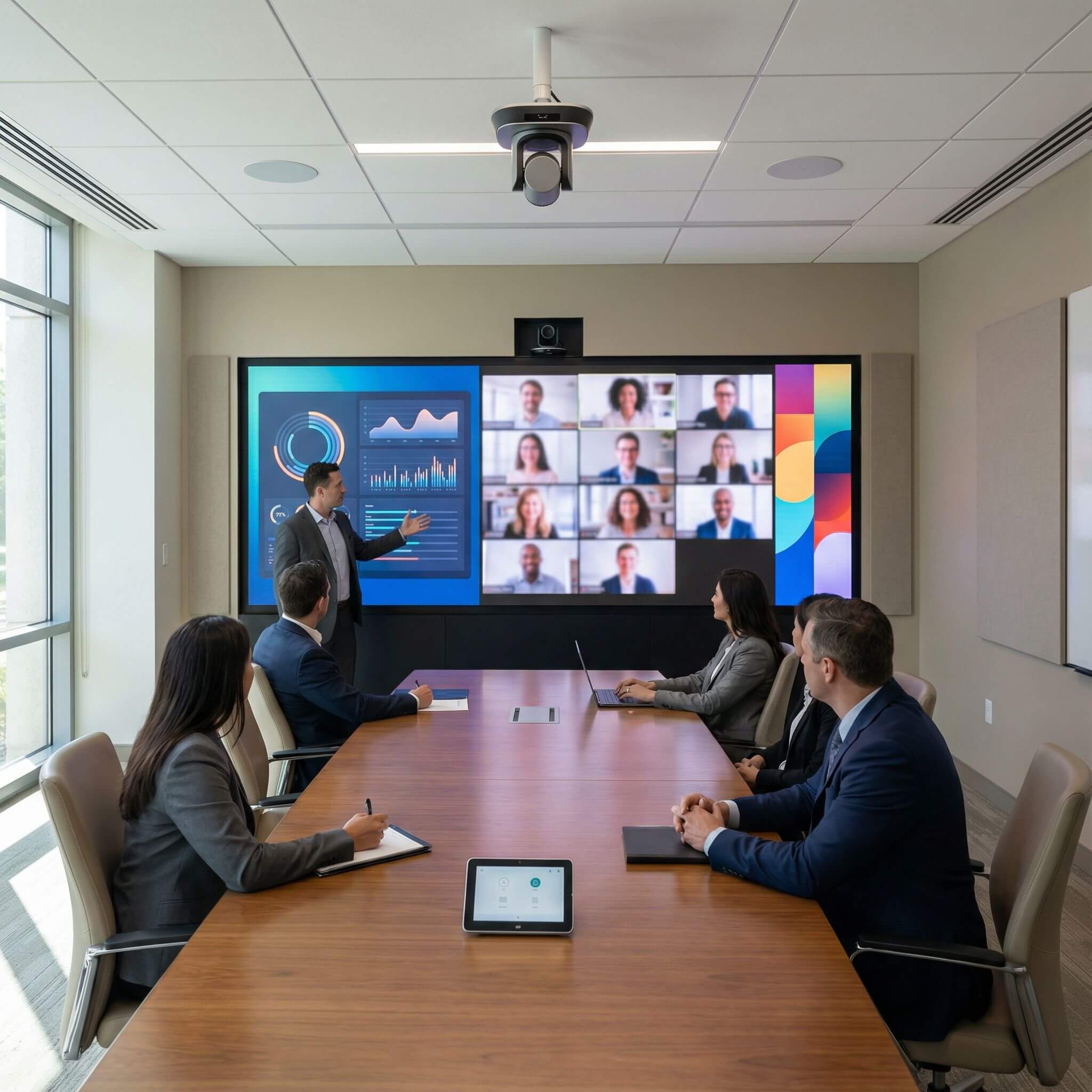
In corporate environments, new standard applications are emerging: townhall areas, experience centers, hybrid conference rooms, and "digital lobbying" with dynamic content. A typical practical example is combining an LED wall with unified communications setup where local presentations, remote participants, and branding content are staged in scenes. Here, not just the display matters but the overall architecture of media technology, control, networking, and operational processes.

In industry and critical infrastructure, demand for large-format visualization increases, such as in control rooms, production monitoring, or logistics. There, requirements like 24/7 availability, low failure tolerance, defined spare parts inventory, and documented maintenance are often contractually fixed. This also changes procurement: rather than one-time hardware acquisition, service contracts, lifecycle planning, and acceptance criteria (uniformity, dead-pixel policy, color drift tolerances) move into the foreground.

In retail and out-of-home, LED walls remain attention-grabbing surfaces but are increasingly regulated and quality-driven. Topics like brightness limiting, glare effects, content compliance, and operational safety are critical, especially in city centers or near traffic. Those investing here must master the balance between visibility and acceptance and embed brightness and operating time control in processes.

Virtual production and broadcast-adjacent use is another growth area, placing high demands on color rendering, scan performance, and synchronization. Companies thinking in this direction should evaluate not just the panel but the interplay with cameras, tracking, render pipelines, and genlock/timing. The market here is more project-driven, and competency in integration and operation often outweighs the lowest purchase price.

Investment and Procurement Decisions: Criteria, Risks, and ROI

For B2B decision-makers, the LED wall is rarely an isolated product but an investment in communication or operational capability. Evaluation should occur via total cost of ownership: acquisition, installation, energy, maintenance, spare parts, failure costs, content creation, and planned reconfiguration. A favorable per-square-meter price quickly becomes relative if service access, calibration stability, or controller architecture do not match the use case.

A proven approach is defining acceptance criteria before contract signing. These include measurable parameters such as maximum and typical brightness (at defined white point), uniformity, color deviation, viewing angle, allowable pixel error classes, noise level, temperature behavior, and recovery times after module replacement. For representative installations, test content scenarios should be specified.

Common risks include insufficient planning data for mounting and substructure, missing reserves in power and climate, and underestimated complexity of signal distribution. In larger systems, network and security perspectives are relevant: who controls content, how are updates deployed, what remote access is permitted, and how is logging configured for compliance? In many organizations, the LED wall is now part of IT risk landscape.

ROI in B2B rarely comes solely from "more attention" but from measurable effects: faster decision processes in control rooms, more efficient communication in hybrid formats, higher quality of stay in customer areas, or reduced travel costs through better remote staging. Returning to the experience center example: consolidating multiple individual displays and projection surfaces into one central LED wall with scene control. ROI emerges from shorter reconfiguration times between customer appointments, lower error rates in signal routing, and consistent brand presentation without manual intervention.

During procurement, the question of "operational reality" also proves valuable. Clarification points include actual operating hours, content mix, integration into existing IT infrastructure, responsibilities for maintenance and updates, and planned service models.

Those solving these points contractually and organizationally reduce long-term risks significantly and create planning certainty over the planned usage period.

Conclusion

The future of LED wall technology will be shaped by three factors: systemically better integrated solutions, higher stability of image quality throughout the lifecycle, and more professional operational models with monitoring, redundancy, and clear service levels. Anyone investing today should not just compare panel specifications but plan the entire chain from content through signal and control to maintenance. This creates sustainable market opportunities: LED walls become a strategic interface for communication, brand, and operations if understood and implemented as critical infrastructure both technologically and organizationally.

Cta V3 Bild
Artikel von

Kampro

Blog-Share-SymbolBlog-Share-SymbolBlog-Share-Symbol
Share on:
Blog Share IconBlog Share IconBlog Share IconBlog Share Icon

Future of LED Wall Technology: Trends, Innovations and Market Development

LED walls in many B2B scenarios are no longer just a "display decision" but an investment in operational and communication capability: as a digital signage surface in retail, as a command-and-control interface in control rooms, as a virtual backdrop in studios, or as a modular event and trade show platform. Correspondingly, questions shift to decision-maker level: What image quality is actually necessary at realistic viewing distances and typical content? What requirements arise for 24/7 operation, service access, spare parts, and acceptance criteria? And what risks emerge if power, climate, signal paths, or responsibilities are only clarified during operation?

In coming years, the market will define itself less by individual maximum values and more by system capability. What matters is how well an LED wall integrates into IT, AV-over-IP, content workflows, building technology, and service processes including redundancy, monitoring, quality control, and traceable security mechanisms, without unnecessarily increasing complexity.

This article contextualizes technological developments and market opportunities, identifies typical decision questions, and provides practical examples for B2B decision-makers who must strategically evaluate LED wall installation investments.

Technology and Product Trends: From Pixel Pitch to System Integration

The most visible trend remains continued development of pixel pitch: in corporate lobbies, conference areas, and broadcast-like environments, smaller pitches become the standard because viewing distances shrink and content becomes more detailed. Simultaneously, the insight spreads that pitch alone does not guarantee image quality. For B2B applications, often more decisive are evenness and mechanical precision, calibration and reproducibility, color volume and consistent color rendering, contrast behavior in ambient light, and display stability over time.

Parallel to this, LED packaging technologies move into sharper focus. While SMD remains economically viable in many scenarios, finer form factors and mini/micro-LED approaches gain importance where higher pixel density and better optical behavior are required. For decision-makers, it is critical to understand the consequences: the finer the structures, the higher the requirements for manufacturing tolerances, repair processes, spare parts strategy, and supply chain quality control.

Another trend is stronger system integration rather than single-component optimization. Modern LED walls are increasingly planned as complete systems with coordinated controller, redundant signal routing, defined color and brightness strategy, and monitoring. In control rooms, for example, not only resolution matters but a robust concept for 24/7 operation, failover, and maintenance windows with clear responsibility assignments between IT, facility, and AV.

Mechanical designs also evolve. Relevant advances include lighter cabinets, faster locking systems, front-side service access, and more precise adjustability. This directly impacts installation times and service costs. A practical example: corporate experience centers where the LED wall is regularly reconfigured for new exhibits. Modularity, repeatable mounting, and documented configuration profiles reduce downtime and minimize the risk of color or brightness deviations after reconfiguration.

Innovations in Image Quality, Efficiency, and Operational Safety

In professional installations, reliability matters more than peak values. Essential are stable calibration processes, clean color space and gamma management, and controlled brightness management. In environments with varying ambient light (entry halls, retail, traffic hubs), intelligent interaction between sensors, presets, and content rules becomes increasingly important so that content remains impactful during the day and does not overshine in the evening.

A central innovation area is reducing moiré, reflections, and unwanted artifacts. Matting, optimized surfaces, and improved scan and driver concepts address effects that occur especially with camera use or fine line patterns. In broadcast studios and virtual production environments, these factors are often purchase-decisive because they directly influence post-production, keying quality, and camera settings.

On energy efficiency, the discussion becomes more nuanced: not just maximum power consumption, but the profile over realistic content mixes. Many B2B applications do not display full white continuously; actual loads depend on content, brightness limiting, and operating times. Serious energy comparisons should define measurement points like typical content scenarios, defined nits, and ambient light conditions, rather than relying on theoretical maximums.

Operational safety is equally important. Redundant power supplies, redundant signal paths, and hot-swap-capable components are often mandatory for 24/7 criticality. In control rooms or production environments, a partial failure can be both an optical problem and an operational or safety risk. A proven practical approach is defining service levels (response time, on-site time, spare parts availability) and deriving technical requirements from them.

Market Development and Application Fields: Growth Drivers in B2B

The LED wall market grows not just through events but increasingly through permanent installations. Drivers include consolidation of communication surfaces (one large, flexible area instead of many individual displays), rising relevance of real-time data, and the desire for immersive customer experiences. At the same time, relative costs per square meter drop in many segments, bringing LED walls into budgets previously reserved exclusively for projectors or LCD video walls.

In corporate environments, new standard applications are emerging: townhall areas, experience centers, hybrid conference rooms, and "digital lobbying" with dynamic content. A typical practical example is combining an LED wall with unified communications setup where local presentations, remote participants, and branding content are staged in scenes. Here, not just the display matters but the overall architecture of media technology, control, networking, and operational processes.

In industry and critical infrastructure, demand for large-format visualization increases, such as in control rooms, production monitoring, or logistics. There, requirements like 24/7 availability, low failure tolerance, defined spare parts inventory, and documented maintenance are often contractually fixed. This also changes procurement: rather than one-time hardware acquisition, service contracts, lifecycle planning, and acceptance criteria (uniformity, dead-pixel policy, color drift tolerances) move into the foreground.

In retail and out-of-home, LED walls remain attention-grabbing surfaces but are increasingly regulated and quality-driven. Topics like brightness limiting, glare effects, content compliance, and operational safety are critical, especially in city centers or near traffic. Those investing here must master the balance between visibility and acceptance and embed brightness and operating time control in processes.

Virtual production and broadcast-adjacent use is another growth area, placing high demands on color rendering, scan performance, and synchronization. Companies thinking in this direction should evaluate not just the panel but the interplay with cameras, tracking, render pipelines, and genlock/timing. The market here is more project-driven, and competency in integration and operation often outweighs the lowest purchase price.

Investment and Procurement Decisions: Criteria, Risks, and ROI

For B2B decision-makers, the LED wall is rarely an isolated product but an investment in communication or operational capability. Evaluation should occur via total cost of ownership: acquisition, installation, energy, maintenance, spare parts, failure costs, content creation, and planned reconfiguration. A favorable per-square-meter price quickly becomes relative if service access, calibration stability, or controller architecture do not match the use case.

A proven approach is defining acceptance criteria before contract signing. These include measurable parameters such as maximum and typical brightness (at defined white point), uniformity, color deviation, viewing angle, allowable pixel error classes, noise level, temperature behavior, and recovery times after module replacement. For representative installations, test content scenarios should be specified.

Common risks include insufficient planning data for mounting and substructure, missing reserves in power and climate, and underestimated complexity of signal distribution. In larger systems, network and security perspectives are relevant: who controls content, how are updates deployed, what remote access is permitted, and how is logging configured for compliance? In many organizations, the LED wall is now part of IT risk landscape.

ROI in B2B rarely comes solely from "more attention" but from measurable effects: faster decision processes in control rooms, more efficient communication in hybrid formats, higher quality of stay in customer areas, or reduced travel costs through better remote staging. Returning to the experience center example: consolidating multiple individual displays and projection surfaces into one central LED wall with scene control. ROI emerges from shorter reconfiguration times between customer appointments, lower error rates in signal routing, and consistent brand presentation without manual intervention.

During procurement, the question of "operational reality" also proves valuable. Clarification points include actual operating hours, content mix, integration into existing IT infrastructure, responsibilities for maintenance and updates, and planned service models.

Those solving these points contractually and organizationally reduce long-term risks significantly and create planning certainty over the planned usage period.

Conclusion

The future of LED wall technology will be shaped by three factors: systemically better integrated solutions, higher stability of image quality throughout the lifecycle, and more professional operational models with monitoring, redundancy, and clear service levels. Anyone investing today should not just compare panel specifications but plan the entire chain from content through signal and control to maintenance. This creates sustainable market opportunities: LED walls become a strategic interface for communication, brand, and operations if understood and implemented as critical infrastructure both technologically and organizationally.
Cta V3 Image
Article by

Kampro

Blog Share IconBlog Share IconBlog Share Icon