
Digital Signage Trends for Reception Areas 2026

LED Wall Tips
Einzelnes Blog-Bild

Digital Signage Trends for Reception Areas 2026

In reception areas in 2026, it often comes down to the first few minutes to determine whether visitor guidance, security requirements, and location communication work seamlessly together. This is where typical practical risks emerge: content is not readable from a distance, systems are too complex to operate daily, or the solution doesn't fit IT and security requirements. At the same time, information should be consistent across locations without local teams being dependent on headquarters for every detail.

For many companies, the choice therefore comes down to one specific decision: Which display technology provides a robust combination of impact, operational reliability, and total cost of ownership under changing lighting conditions and with high visibility – and can be reliably operated across multiple locations? In this context, LED walls increasingly come into focus because they offer scalability, brightness, and design freedom that traditional signage displays can only partially achieve.

This article shows which technologies and design approaches prevail in reception areas, what decision questions B2B decision-makers typically need to answer, and how reliable investment and rollout decisions for company locations can be derived from this.

Technology Shift 2026: Why LED Walls in Reception Areas Become the New Standard

The most important in brief: In reception areas, high visibility, long operating hours, and low operational complexity come together. For central lobby spaces, an LED wall is therefore increasingly specified, while professional LCD/LED displays remain relevant for clearly defined applications.

In 2026, three requirements clash in reception areas: high visual presence, long operating hours, and minimal complexity in daily operations. This is exactly where the market is noticeably shifting toward LED walls. While professional LCD/LED displays continue to have their justification for specific uses, LED is increasingly specified for signature walls in foyers and lobby zones.

The main driver is the combination of scalability and brightness reserve. Reception areas are often architecturally open-designed, with daylight and reflective surfaces. An LED wall can work here with high luminosity and stable contrast without washout in bright situations.

Crucial for B2B calculations in 2026 is less "LED is better" but rather which LED configuration fits the use case. This determines pixel pitch, brightness, redundancy, and content design.

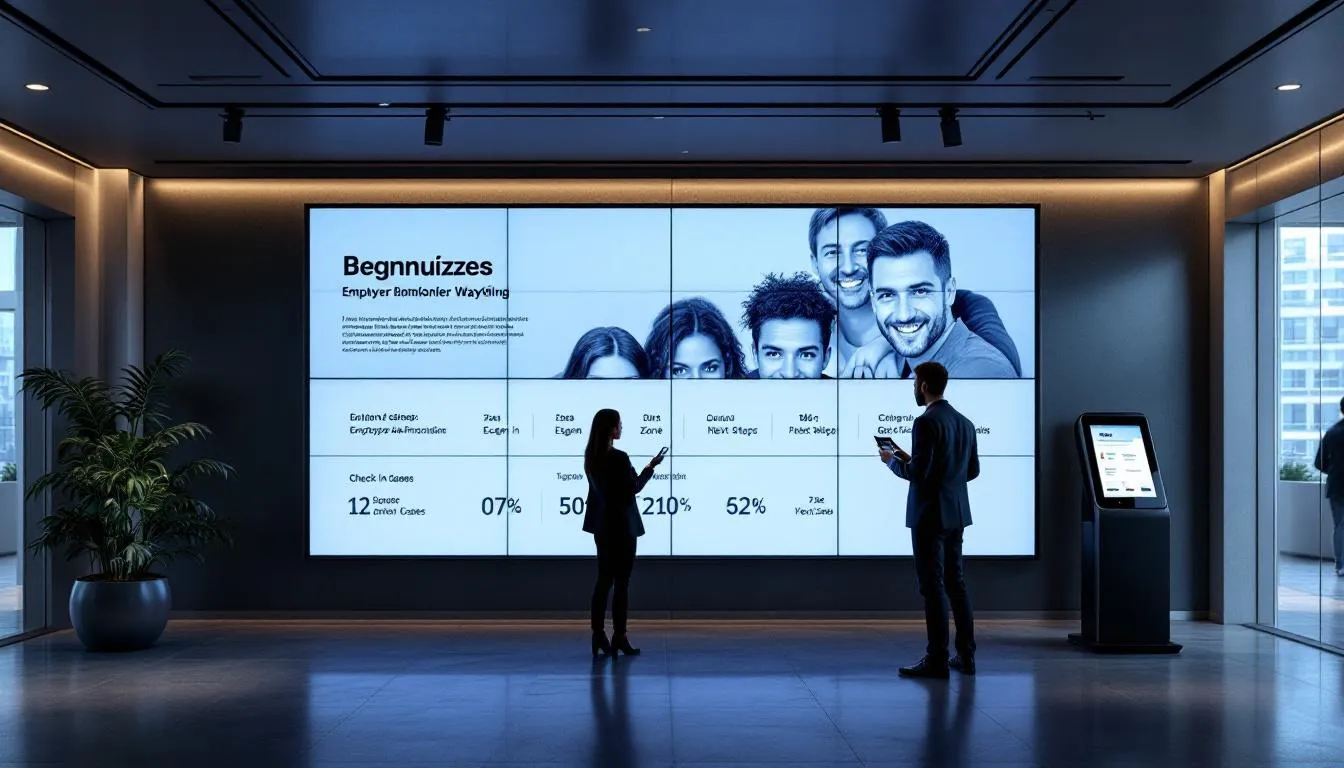
A practical example: In a headquarters foyer with 4–8 m viewing distance, an LED wall is often chosen that masters both sharp typography and atmospheric brand images. At the same time, a smaller screen is added for interactive functions so the large surface isn't consumed by touch interaction or UI overlays.

The operational side is also a driver. Modern LED systems increasingly offer modular maintenance with hot-swap modules and optional redundancy in power and signal paths. For reception areas, this matters because failures are immediately visible. Many companies assess the LED wall as "critical infrastructure" with defined service levels and spare parts concepts.

For investment decisions: An LED wall is particularly worthwhile when planned as a central communication surface fulfilling multiple purposes and used unchanged over years. For static information only, high-quality signage displays are often more economical.

Design Approaches that Prevail: From Welcome Screens to Context-Sensitive Visitor Experience

Digital signage in 2026 is planned as a coherent visitor journey, not as individual screens. Content is structured in layers: brand image as background, dynamic information modules above, and situational cues beside.

For an LED wall, content must be optimized for readability from a distance and motion economy. Working well are layouts with few core messages, high contrast guidance, and clear time windows.

A 2026 trend is context sensitivity without excessive personalization. Companies increasingly want meaningful visitor group addressing without personal recognition. Accessibility standards as design specifications—adequate font sizes, clear icons, no color-coded-only information, defined minimum contrasts—ensure comprehensibility for all.

System Architecture in B2B: CMS, Integrations, Security, and Operations

Technology decisions rarely fail because of image quality but because of operations, governance, and integrations. Digital signage is part of the IT and security landscape: content comes from multiple sources and must be approved.

At the center is a signage CMS with clear role logic. A template approach with locked layout zones lets local teams update content while maintaining design integrity. The CMS should support timelines, triggers, approval workflows, and versioning.

Security requirements are increasingly strict: network segmentation, player hardening, central certificates, logging, and defined update processes. Controllers/processors should fit IT policies, enable remote management, and be clearly diagnosable.

A practical rollout model is "Core & Local": central content from headquarters, local content locally maintainable within defined templates. This scales operations reliably.

Investment and Rollout Decisions: Specification, TCO, and Proof-of-Concept

Investment decisions in 2026 are evaluated as location-spanning portfolio cases. Decisive are specifications from use scenarios, realistically calculated TCO, defined service levels, and proof-of-concept under real conditions.

Specification starts with use scenarios. From this, technical criteria emerge: pixel pitch, brightness/dimmability, color stability, controller redundancy, and maintenance access.

TCO often underestimates content creation, integrations, training, and personnel. An LED wall may have higher purchase price but can reduce costs by replacing multiple communication tasks and physical media.

Service level is central: defined response times, clear responsibilities, spare parts concepts, remote diagnostics. For reception areas, an SLA-oriented approach is essential because downtime has reputational impact.

A proof-of-concept under real conditions validates readability, light behavior, and editorial processes. For multi-location rollouts, a staged model proves beneficial: pilot location, early adopter locations, then scaled rollout with standardized hardware and system logic.

FAQ and Conclusion

When is an LED wall in reception areas worthwhile? When the reception area serves as central communication and brand surface, high visibility is needed, and content remains flexible over years.

What typical errors occur with LED walls? Design and process errors: too small text, too much content, restless animations, or no content governance. Technical errors: lack of redundancy, unclear responsibilities, unmanaged player operations.

Which integrations provide greatest benefit? Visitor management and room booking reduce recurring questions. Crisis communication integration ensures defined content appears in emergencies. Data minimization is crucial.

How do you make location-spanning reliable decisions? Use a portfolio approach with few standardized profiles, central templates, and clear operations concepts. Proof-of-concept under real conditions validates the approach.

Conclusion

2026 brings a clear vision: digital signage as controllable, secure, standardized platforms. The LED wall becomes standard for central lobby surfaces because it combines impact, scalability, and flexibility. Crucial are content governance, integrations, security, and reliable service models.

Those who specify from use scenarios, evaluate TCO realistically, and establish standards can reliably scale visitor information. This transforms nice digital surfaces into functional systems that improve visitor flows, support processes, and professionalize location communication.

Cta V3 Bild
Artikel von

Kampro

Blog-Share-SymbolBlog-Share-SymbolBlog-Share-Symbol
Share on:
Blog Share IconBlog Share IconBlog Share IconBlog Share Icon

Digital Signage Trends for Reception Areas 2026

In reception areas in 2026, it often comes down to the first few minutes to determine whether visitor guidance, security requirements, and location communication work seamlessly together. This is where typical practical risks emerge: content is not readable from a distance, systems are too complex to operate daily, or the solution doesn't fit IT and security requirements. At the same time, information should be consistent across locations without local teams being dependent on headquarters for every detail.

For many companies, the choice therefore comes down to one specific decision: Which display technology provides a robust combination of impact, operational reliability, and total cost of ownership under changing lighting conditions and with high visibility – and can be reliably operated across multiple locations? In this context, LED walls increasingly come into focus because they offer scalability, brightness, and design freedom that traditional signage displays can only partially achieve.

This article shows which technologies and design approaches prevail in reception areas, what decision questions B2B decision-makers typically need to answer, and how reliable investment and rollout decisions for company locations can be derived from this.

Technology Shift 2026: Why LED Walls in Reception Areas Become the New Standard

The most important in brief: In reception areas, high visibility, long operating hours, and low operational complexity come together. For central lobby spaces, an LED wall is therefore increasingly specified, while professional LCD/LED displays remain relevant for clearly defined applications.

In 2026, three requirements clash in reception areas: high visual presence, long operating hours, and minimal complexity in daily operations. This is exactly where the market is noticeably shifting toward LED walls. While professional LCD/LED displays continue to have their justification for specific uses, LED is increasingly specified for signature walls in foyers and lobby zones.

The main driver is the combination of scalability and brightness reserve. Reception areas are often architecturally open-designed, with daylight and reflective surfaces. An LED wall can work here with high luminosity and stable contrast without washout in bright situations.

Crucial for B2B calculations in 2026 is less "LED is better" but rather which LED configuration fits the use case. This determines pixel pitch, brightness, redundancy, and content design.

A practical example: In a headquarters foyer with 4–8 m viewing distance, an LED wall is often chosen that masters both sharp typography and atmospheric brand images. At the same time, a smaller screen is added for interactive functions so the large surface isn't consumed by touch interaction or UI overlays.

The operational side is also a driver. Modern LED systems increasingly offer modular maintenance with hot-swap modules and optional redundancy in power and signal paths. For reception areas, this matters because failures are immediately visible. Many companies assess the LED wall as "critical infrastructure" with defined service levels and spare parts concepts.

For investment decisions: An LED wall is particularly worthwhile when planned as a central communication surface fulfilling multiple purposes and used unchanged over years. For static information only, high-quality signage displays are often more economical.

Design Approaches that Prevail: From Welcome Screens to Context-Sensitive Visitor Experience

Digital signage in 2026 is planned as a coherent visitor journey, not as individual screens. Content is structured in layers: brand image as background, dynamic information modules above, and situational cues beside.

For an LED wall, content must be optimized for readability from a distance and motion economy. Working well are layouts with few core messages, high contrast guidance, and clear time windows.

A 2026 trend is context sensitivity without excessive personalization. Companies increasingly want meaningful visitor group addressing without personal recognition. Accessibility standards as design specifications—adequate font sizes, clear icons, no color-coded-only information, defined minimum contrasts—ensure comprehensibility for all.

System Architecture in B2B: CMS, Integrations, Security, and Operations

Technology decisions rarely fail because of image quality but because of operations, governance, and integrations. Digital signage is part of the IT and security landscape: content comes from multiple sources and must be approved.

At the center is a signage CMS with clear role logic. A template approach with locked layout zones lets local teams update content while maintaining design integrity. The CMS should support timelines, triggers, approval workflows, and versioning.

Security requirements are increasingly strict: network segmentation, player hardening, central certificates, logging, and defined update processes. Controllers/processors should fit IT policies, enable remote management, and be clearly diagnosable.

A practical rollout model is "Core & Local": central content from headquarters, local content locally maintainable within defined templates. This scales operations reliably.

Investment and Rollout Decisions: Specification, TCO, and Proof-of-Concept

Investment decisions in 2026 are evaluated as location-spanning portfolio cases. Decisive are specifications from use scenarios, realistically calculated TCO, defined service levels, and proof-of-concept under real conditions.

Specification starts with use scenarios. From this, technical criteria emerge: pixel pitch, brightness/dimmability, color stability, controller redundancy, and maintenance access.

TCO often underestimates content creation, integrations, training, and personnel. An LED wall may have higher purchase price but can reduce costs by replacing multiple communication tasks and physical media.

Service level is central: defined response times, clear responsibilities, spare parts concepts, remote diagnostics. For reception areas, an SLA-oriented approach is essential because downtime has reputational impact.

A proof-of-concept under real conditions validates readability, light behavior, and editorial processes. For multi-location rollouts, a staged model proves beneficial: pilot location, early adopter locations, then scaled rollout with standardized hardware and system logic.

FAQ and Conclusion

When is an LED wall in reception areas worthwhile? When the reception area serves as central communication and brand surface, high visibility is needed, and content remains flexible over years.

What typical errors occur with LED walls? Design and process errors: too small text, too much content, restless animations, or no content governance. Technical errors: lack of redundancy, unclear responsibilities, unmanaged player operations.

Which integrations provide greatest benefit? Visitor management and room booking reduce recurring questions. Crisis communication integration ensures defined content appears in emergencies. Data minimization is crucial.

How do you make location-spanning reliable decisions? Use a portfolio approach with few standardized profiles, central templates, and clear operations concepts. Proof-of-concept under real conditions validates the approach.

Conclusion

2026 brings a clear vision: digital signage as controllable, secure, standardized platforms. The LED wall becomes standard for central lobby surfaces because it combines impact, scalability, and flexibility. Crucial are content governance, integrations, security, and reliable service models.

Those who specify from use scenarios, evaluate TCO realistically, and establish standards can reliably scale visitor information. This transforms nice digital surfaces into functional systems that improve visitor flows, support processes, and professionalize location communication.
Cta V3 Image
Article by

Kampro

Blog Share IconBlog Share IconBlog Share Icon